The Week Before the SAT: What Should You Actually Be Doing?


After months of preparing for the SAT, the final week can feel surprisingly stressful. You might wonder if you should squeeze in one more full-length practice test, learn a few last-minute math concepts, or simply hope everything you’ve studied sticks. It’s easy to feel like there’s still so much left to do.
The truth is, the week before the SAT isn’t about learning everything you don’t know. At this point, your goal should be to identify what will have the biggest impact on your score, strengthen your test-taking habits, and make sure you arrive on test day ready to perform your best. Here’s how to make the most of those final seven days.
What Should My Final Week Look Like?
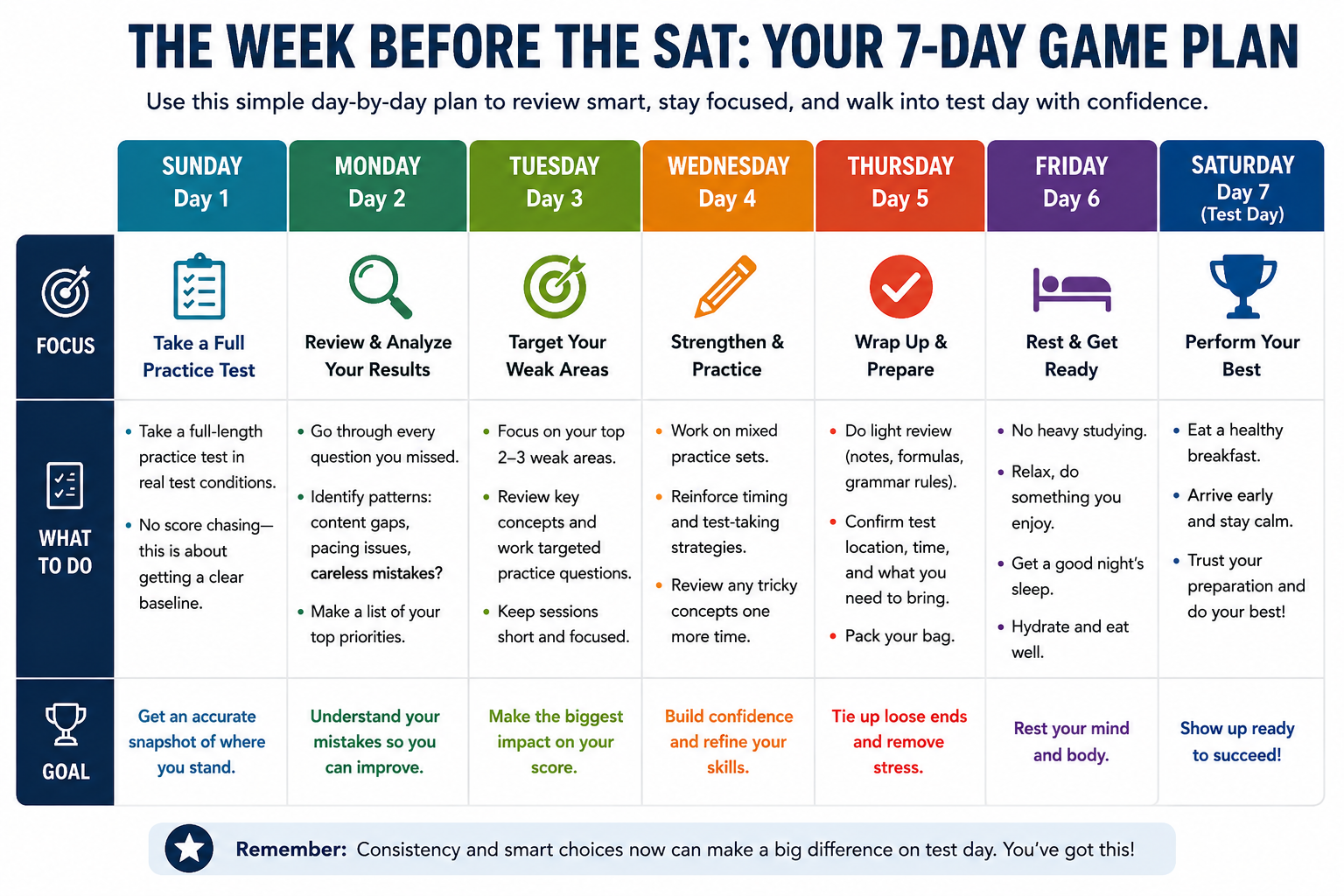
The exact way you spend your final week will depend on what your practice test reveals, but having a simple plan can help you stay focused without feeling overwhelmed. Instead of wondering what to study each day, give yourself a clear purpose for the week.
Early in the week, take your final full-length practice test and review every mistake carefully. This is your opportunity to identify patterns and decide where your remaining study time will have the greatest impact.
In the middle of the week, spend your study sessions reinforcing your weakest areas while continuing to practice the skills you’ve already developed. Short, focused review sessions are usually more productive than marathon study days.
As test day approaches, begin shifting your attention away from learning new material. Confirm your testing location, gather everything you’ll need, and make sleep a priority. By the day before the exam, your goal should be to feel prepared, not exhausted.
Think of your final week as a transition. The first few days are for evaluating and refining your preparation. The last few days are for making sure you’re ready to perform your best when it counts.
Should I Take One More Practice Test?
Yes, but timing matters.
If you haven’t taken a full-length practice SAT recently, schedule one near the beginning of the week. Monday or Tuesday is ideal. That gives you enough time to review your results and make meaningful adjustments before test day.
Treat this practice test exactly like the real thing. Work in a quiet environment, follow the official timing, and avoid looking up answers as you go. The goal isn’t simply to generate another score. It’s to get one last snapshot of where you stand.
Once you’ve finished, resist the temptation to immediately move on to another practice exam. One carefully reviewed test is usually much more valuable than several rushed ones.
How Do I Figure Out What Still Needs Work?
Your practice test score tells you how you performed. Your mistakes tell you what to do next.
As you review your incorrect answers, don’t just check which questions you missed. Ask yourself why you missed them.
Were you unfamiliar with the concept? Did you misread the question? Did you rush because you were running out of time? Or was it simply a careless mistake?
Looking for patterns helps you spend your remaining study time wisely. If most of your missed Math questions involve quadratic equations, that’s a clear topic to review. If you consistently lose points because you’re reading too quickly, practicing your pacing may do more for your score than learning another formula.
Understanding why mistakes happen is often just as important as correcting them.
Should I Learn New Material This Week?
Probably not, at least not in large amounts.
The final week before the SAT usually isn’t the best time to work through entirely new topics or try to master concepts you’ve never understood before. Most students see greater improvement by strengthening skills they already have than by cramming unfamiliar material at the last minute.
That doesn’t mean you should avoid learning anything new. If your final practice test reveals one specific weakness, such as a grammar rule that keeps appearing or a type of algebra problem you consistently miss, spending some time reviewing that topic can still be worthwhile. The key is to be selective.
Ask yourself whether a topic is likely to improve your score in just a few days. If the answer is yes, it’s probably worth reviewing. If mastering it would require weeks of practice, your time is probably better spent improving your accuracy, pacing, and confidence in areas where you’re already close to success.
As the SAT gets closer, your goal shifts from expanding your knowledge to making the most of what you already know.
What Should I Focus On During My Last Week?
Once you’ve identified your biggest opportunities for improvement, it’s time to prioritize.
Many students make the mistake of trying to review every topic that could appear on the SAT. That’s rarely the best strategy. Instead, focus on the areas most likely to improve your score.
For example, if punctuation rules have been costing you several questions on every Reading and Writing module, reviewing Standard English Conventions may give you a better return than spending hours on topics you’ve already mastered. Likewise, if your algebra skills are strong but geometry continues to slow you down, dedicate more time to geometry.
Think about where you can realistically improve over the next few days. Small gains in your weakest areas often make a bigger difference than reviewing material you already know well.
Should I Keep Studying Every Day?
Yes, but your study sessions should probably look different than they did a month ago.
Instead of spending four or five hours studying at a time, focus on shorter, more intentional practice sessions. An hour of focused review often produces better results than several hours of distracted studying.
Mix together different types of practice. Review a few math problems, work through some Reading and Writing questions, and revisit concepts you’ve recently struggled with. This helps keep your skills sharp without overwhelming yourself.
It’s also important to leave time to rest. Mental fatigue can make it harder to concentrate, especially during a long exam. The goal isn’t to study as much as possible. It’s to arrive on test day mentally fresh.
Don’t Forget the Details Outside of Studying
The week before the SAT isn’t just about academics. It’s also the time to make sure every practical detail is taken care of so you can feel relaxed and confident for the exam.
Before test day, confirm that you know:
- Where you’ll be taking the SAT
- What time you need to arrive
- How you’ll get there
- What identification or admission information you’ll need
- Whether your calculator is working properly
- What you’ll bring for snacks and water during your break
Handling these details early helps eliminate unnecessary stress on test morning. The fewer decisions you have to make that day, the easier it is to focus on the exam itself.
Should I Study the Night Before the SAT?
A little review is fine. A marathon study session is not.
The day before your exam is a good time to look over notes, review a few practice questions, or revisit formulas and grammar rules you’ve already learned. It’s generally not the time to dive into entirely new concepts or take another full-length practice test.
More importantly, prioritize getting enough sleep.
Sleep plays an important role in memory, concentration, and problem-solving. Losing several hours of rest in exchange for a little extra studying usually isn’t a good trade. By the night before the SAT, your preparation is largely complete. Your job is simply to show up ready to use it.
How Do I Know If I’m Ready?
It’s normal to feel nervous before any standardized test. Almost every student wonders whether they’ve done enough.
Instead of asking whether you know everything that could appear on the SAT, ask yourself a different question: Do I have a plan for the test I know is coming?
If you’ve completed practice tests, reviewed your mistakes, strengthened your weakest areas, and prepared for test day, you’ve already done much of what successful students do. No one walks into the SAT knowing every answer. The goal isn’t perfection. It’s performing as well as you can with the preparation you’ve built.
Finish Strong
The final week before the SAT isn’t about cramming every remaining topic into your schedule. It’s about making smart decisions with the time you have left. A well-reviewed practice test, targeted study sessions, consistent sleep, and good test-day planning can all help you feel more confident when exam day arrives.
Remember, the SAT rewards preparation just as much as knowledge. If you want expert guidance on what to study, how to improve your score, and how to make every practice session count, browse our SAT course catalog and find the Prep Expert® program that helps you walk into test day ready for success.
Written by Dr. Shaan Patel MD MBA
Prep Expert Founder & CEO
Shark Tank Winner, Perfect SAT Scorer, Dermatologist, & #1 Bestselling AuthorMore from Dr. Shaan Patel MD MBA


The Myth of the “Naturally Brilliant” Student
“I was the valedictorian of my high school and I scored a 1760 the first time I took the SAT.”…

How Many Times Should You Take the SAT? Most Students Stop Taking the SAT One Sitting Too Early
There is a right answer to this question, and most families don't land on it. Some students take the SAT…

The Test AI Can’t Take for You: Why SAT Prep Now Means Learning to Think, Not Memorize
The College Board published research on 23rd September finding that 92% of AP teachers surveyed worry generative AI will leave…